Prototyping and testing agency in Barcelona, validate before you build

Functional prototypes, real-user tests and concept validation so development starts with certainty, not assumptions.

Validate before you build, eliminate risk and save time

The most expensive mistake in digital product development isn't a code bug: it's building something users don't understand, don't need or don't know how to use. Prototyping and user testing are the tools that eliminate that risk before your development team invests a single hour in building it.
At Lucid_, prototyping is not about making pretty screens in Figma. It's about simulating the real behaviour of the product, putting it in front of real users and gathering evidence that drives product decisions. The result is a development team that starts with certainty and a product that reaches the market with fewer costly iterations.

AI as part of how we work

Artificial intelligence (Figma Make, Claude, Antigravity, Stitch) has changed the speed at which we prototype and the ease with which we produce variants. At Lucid_ AI is part of our standard process, not a differentiated service or a technology novelty, it's simply how we work today.
Tools like Figma Make allow us to go from a flow description or a brief to an interactive prototype in a fraction of the time it previously required. This doesn't change what gets tested or with whom, validation is still done with real users, but it means we arrive at the testing moment with more options explored, faster.

More variants, more options to test

One of the most concrete advantages of using AI in the prototyping phase is the ease of producing multiple variants of the same flow or screen. We can explore different approaches to the same solution without multiplying production time, which expands the solution space that reaches user tests and makes it easier to spot opportunities that would otherwise fall outside the project's scope.

POCs and new product exploration

For companies exploring new products or business models, we develop functional Proof of Concept (POC) prototypes that allow putting an idea in front of real users before committing development resources. The combination of fast prototyping and structured user tests is the most efficient way to reduce uncertainty in the early stages of innovation.
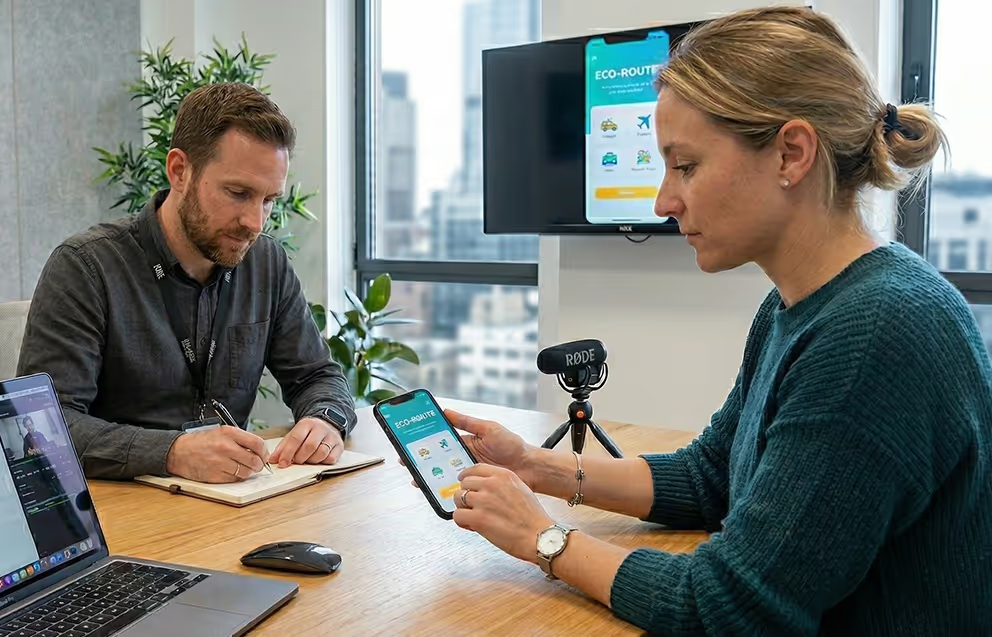
User interacting with a prototype during moderated usability testing in a controlled environment.

Our prototyping and testing services

We design prototypes adapted to the project phase: low-fidelity wireframes to validate information architecture and main flows, and high-fidelity prototypes in Figma to test the visual experience and microinteractions before development. Each prototype is designed to be testable, not just presentable.

Moderated and remote usability tests

We run usability tests with real users matching the product's target profile. We work in both moderated format (individual sessions with a facilitator) and unmoderated remote tests. We observe, record and analyse how users interact with the prototype: where they stop, what they don't understand, what creates friction and what works well.

Concept and functional viability tests

Before prototyping, we evaluate whether the idea makes sense to users. Concept tests allow us to measure the appeal, comprehension and perceived utility of a proposal before investing in detailed design. Ideal for validating new features, business models or value propositions.

Insight reports with actionable recommendations

Every testing session produces a prioritised insight report. We don't deliver raw data reports: we synthesise findings into concrete recommendations, prioritised by impact and effort, ready to be integrated into the product team's backlog.

Digital prototyping_ User testing_ Task Scenarios_

FAQ: Frequently asked questions about prototyping and testing

As early as possible. Prototyping is useful from the discovery phase (to validate the problem) to the pre-development phase (to validate the solution). The earlier you prototype and test, the cheaper it is to correct. A change in a prototype costs minutes; the same change in production can cost days.

How many users do I need for a usability test?

For qualitative tests, 5 to 8 users per profile are enough to identify the main usability issues. For quantitative tests (A/B, success metrics), sample size varies by required confidence level. We advise on the most appropriate approach depending on your objective.

Can you do prototyping and testing if we already have in-house designers?

Yes. Many companies with in-house design teams engage us for testing and research phases because they require an external perspective and specialised methodology. We can also complement your team during high-workload phases or projects that require AI-powered prototyping speed.

What's the difference between AI-powered and traditional prototyping?

Production speed and the ease of generating variants. We can go from a brief to a functional prototype in hours and explore multiple approaches to the same flow without multiplying work time. This doesn't change how we validate,  validation is still done with real users, it changes how much solution space we can explore before the test.

Are tests done remotely or in person?

We offer both. Remote tests give us access to users of any geographic profile with greater speed. In-person tests are preferred when the product or context of use requires detailed observation. For most projects, moderated remote tests offer the best balance between insight quality and cost.

How long does a prototyping and testing cycle take?

A complete cycle of prototyping + testing + report can be completed in 2-4 weeks, depending on scope. With AI tools integrated in the process, initial prototypes can be ready in 3-5 days, significantly compressing timelines compared to traditional methods.

Let’s start a conversation

We are open to innovation and human-focused industrial design commissions and creative collaborations.
Thank you! Your submission has been received!
Oops! Something went wrong while submitting the form.